In November last year, writing for The Guardian newspaper, Jonathan Jones wrote an interesting article entitled “Flat, soulless and stupid: why photographs don’t work in art galleries.” His main point was that while photographs are many things, they are not suitable for hanging in art galleries in the way paintings are. It is hard not to reach the conclusion (although never directly stated) that Mr. Jones might even consider that photographs aren't actually art at all.
Paintings are made with time and difficulty, material complexity, textural depth, talent and craft, imagination and “mindfulness”. A good painting is a rich and vigorous thing. A photograph, however well lit, however cleverly set it up, only has one layer of content. It is all there on the surface. You see it, you’ve got it. It is absurd to claim this quick fix of light has the same depth, soul, or repays as much looking as a painting by Caravaggio – to take a painter so many photographers emulate.
It's certainly an interesting view, and obviously a provocative one, but it's most useful function is in calling us back to the question (so often referred to in this blog), of what makes a great photograph. To me, justification for hanging in a gallery should not be based on whether or not the work is a photograph or a painting, but on it's inherent quality.
There is also the difficulty of definition. So often, particularly recently, photographs are not simply an accurate representation of what was photographed, but are altered both during (using blur or long exposures for example) and after exposure (the most obvious example being photographic compositions). Likewise, artists whose medium is primary paint, have been experimenting with photo collages and other approaches to express themselves, perhaps most notably David Hockney whose latest exhibition was actually entitled Painting and Photography, and who believes that technology has always been used alter pictures, including those of the great masters. This has been to widely suggested of Johannes Vermeer, and an interesting article on the subject and his possible use of the Camera Obscura can be found at the Essential Vermeer website.
One of my favourite works by Vermeer, Girl with a Pearl Earring, is an interesting painting in the context of this discussion - is it possible for a photograph to have the same impact? Perhaps, but one of the advantages the painter has long enjoyed is the ability to concentrate on the essential detail in their work. In Vermeer's painting below for example, he can concentrate on the beauty of light and colour by using shading rather than the precise replication of the photograph. This allows greater artistic expression than the photographer normally has, although this is being challenged, particularly in the digital world, where composites and digital techniques can emulate some of these advantages.
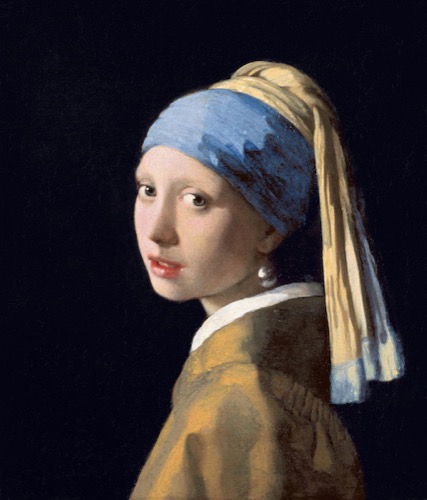
Girl with a pearl earring by Johannes Vermeer (1632-1675).
The meeting place between photography and painting - the photographic composite
The use of photographic compositing is a fascinating area and one which can allow the photographer greater freedom of expression. I consider photographic compositing as similar to the movement in painting away from realism towards abstraction. A photograph can record in astonishing detail that which is found in the world, but by combining a range of photographs an artist can create new work that represents what is in their mind's eye in the same way as impressionist or abstract artists might represent their own imaginings.
Works such as “Isostacy” by Julianne Kost are great examples of this, and for those interested, in the video below Ms. Kost talks through the process of creating the image.
In my own early and basic composite below, I was able to give expression to a simple seaside image by combining different images and textures in a way I couldn't achieve in my traditional photography. Although very unsophisticated, the scene represents what I felt about the image rather than simply representing what was seen through the lense of the camera.
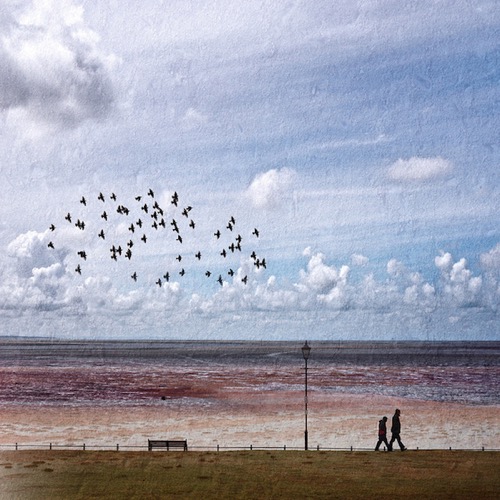
Basic composite of promenade scene at Lytham St. Annes.
The advantage the camera - capturing the moment
Finally, Mr. Jones's article makes a particular point of comparison between photography such as that by David Titlow that won the Taylor Wessing photographic portrait prize, and great works of art such as Rembrandt's late work. What this neglects to take into account however is the “decisive moment” in photography, something that provides a unique advantage to the photographer. It is work such of that of Sergio Larrain, captured in one “moment of grace”, that requires us to consider not just what is on the surface of the image, but what is present at that particular, never to be repeated moment. As Henri Cartier-Bresson says:
For me the camera is a sketch book, an instrument of intuition and spontaneity, the master of the instant which, in visual terms, questions and decides simultaneously.
From “In the Minds Eye: Writings on Photography and Photographers."
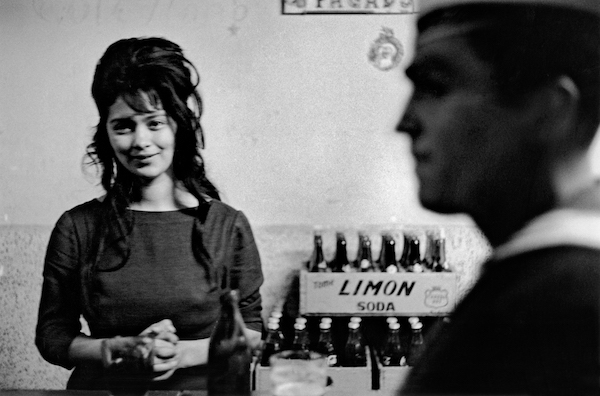
Chile. Valparaiso. 1963. © Sergio Larrain, Magnum Photos.
Please email me should you have a comment or query relating to this post.
← Dark cloud over Jubilee Tower | Post Archive | The power of the triptych →