Any reader of this blog will be aware of my interest in the photo composite as an art form, and it is certainly an area I wish to develop personally and write about more. This post is intended both as my “central reference” about photo compositing, and an account of my journey in trying to employ the technique in my own creative expression. I hope that it will be both interesting and useful for others. I'll talk about what draws me to this art form, my own approach to it, and signpost further resources. I claim no particular talent other than my interest and enthusiasm! Please let me know if you would like anything included, or if you know about a particular resource or example you would like me to include. Unlike my usual posts, I intend this article to be a starting point that will be regularly added to and updated.
What is a photo composite?
In essence a photo composite is an image formed by superimposing a number of separate photographs together. It should be remembered that the photograph can be of a texture (often used to bind elements of the composite together) as well as the subjects normally associated with photography. Photo composites are famously used to create “impossible” pictures, for example where the same person appears on the photograph a number of times, and have also be used to deceive. One of the most famous early examples of the latter was the “The Cottingley Fairies,” a series of pictures taken in the early 20th Century and supposedly capturing fairies in a photograph. Nowadays photo composites are usually created using Adobe Photoshop, and are sometimes called “Photoshop Composites” due to the wide use of the software.
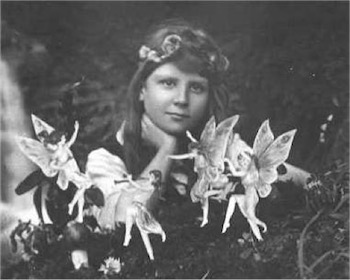
The ‘Cottingley Fairies
A fascinating (if a little sinister) sidenote to photo compositing was work conducted by Sir Francis Galton in the 1880s to create the “average” face of “different types”. For further information on this area there is an interesting online collection at the Metropolitan Museum of Art.
Why I work with on photo composites as well as normal photographs
I have had a long fascination with photography, and love the visual arts in a wide variety of ways; as a historical photographic record, as breathtaking moments of grace when “the present” is caught and held, in abstraction, and in the wondrous beauty of a wide variety of images that, however unexpectedly, resonate with that which ennobles us. In short, I'm enthralled with the message an image gives or feeling it evokes, over and above the actual medium used to create that image.
Taking into account the above, and with a passion for photography and painting, I am naturally drawn to the idea of the photo composite, not to create clever illusions or to “cheat”, but to liberate me to express more readily my own ideas. I particularly love the freedom of expression that the composite provides.
I do sometimes worry that a combining images is somehow a compromise (goodness knows where I've got that from), but my steps so far have helped reassure me that it's not.
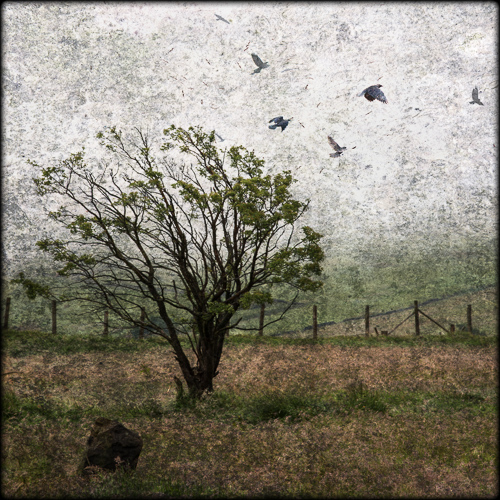
Tree and birds.
Principles for photo compositing
I've decided to record a set of principles to help be keep focussed on what I want for my own photo composites, not because they are unique in any way (in fact they have been derived for my research into the area) but to serve as a anchor for me when creating my own work. I imagine I will add to them as I become more experienced.
Principle one - the story
The first principle is also the most important one, start with the story you want to tell. The biggest excitement to me in photo compositing is that you can combine elements to make up the image you want, and bring in different aspects of the external world (which you have photographed) to make up the landscape of your internal one. There seems to be a real parallel here between the process of compositing and dreaming - both seem to be made up of elements that have somehow evoked an emotional or intellectual response in you, for the photographer it gives the new experience of add your own elements into an image rather than relying on that which presents itself - although I know it's not as simple as that I hope you understand my meaning.
It's important to relise that your theme or story need not be your own, but can be a response to what you might have read, heard or experienced. For example, my latest composite, “Mariabronn,” is based on one of my favourite novels, “Narciss and Goldmund” by Hermann Hesse. Please see my post about creating “Mariabronn” for further details.
After saying all that, rules are made to be broken, and if the mood takes you and you feel the urge to simply experiment - go for it!
Principle two - use your own materials
I like to do this to ensure that the finished work is unique to me and also because it somehow confers a sense of integrity. Use only your own photographs - places that move you, textures you like, beautiful clouds - anything that has compelled you to photograph them. You respond to things for a reason, and there is nothing wrong (and everything right) with including them in your work.
Principle three - master your craft
It would be disingenuous of me to pretend that photo compositing of the type I'm talking about does not require some knowledge of digital software techniques. Learn as much as possible about your tools and don't apologise for them. An artist gets to know his paints and canvas and you must master your camera and software. In the end, it all comes back to creating a piece of art. Never assume that some of the greatest artists whoever lived wouldn't be using digital medium if they were born today.
Principle four - practise and experiment
If you are anything like me, you will discover the image you were hoping to produce, the one you saw in your ‘mind's eye’ has no resemblance to the one you produce. Persevere, and have faith in your work, like any endeavour you will find it improves.
Posts realting to photo compositing on this site
“Making Mariabronn” - how I created a photo composite using one of my favourite novels as a starting point. “Flat, Soulless and Stupid” - a post about painting and photography. “Young, Leafed June” - a post with an example of one of my early composites. The online gallery of my own composite work
Further resources
I will update these resources regularly; there is much out there, and these are the one's I've found and like.
Julieanne Kost
I put Ms. Kost as my primary resource (and have mentioned her elsewhere on this site) because she was (and remains) the inspiration for my own work in this area and what little I know of it has largely come from the wealth of material she has created relating to the creation of photo compositing. Ms. Kost works for Adobe, and although her advice on the use of Adobe's software is excellent, it is her inspiration and advice on the creative endeavour I find even more useful. Ms. Kost's resources (both free and paid) have helped me enormously to understand the process and art involved in photo compositing, and I am a great admirer of her work.
Freely available compositing videos by Julieanne Kost:
IsostacyHindsightTwilightLayering ElementsLynda.com
As mentioned, there is a wealth of freely available material on the Internet on how to create a photo composite (including the excellent work above). I have also signed up to Lynda.com to go through their paid courses on compositing and the use of software such as Adobe Photoshop(there are comprehensive courses by the aforementioned Ms. Kost for example, and a great one on Photographing for Compositing by Sean Duggan). To be honest there are courses on just about anything, and they really are excellent.
Artist websites
- Erik Johansson - Stunning images put together with great skill and imagination. A modern day Dali!
- Sean Duggan - check out Sean's website for a range of information but particularly his Technigue page for a Fine Art Composite presentation. I also throughly enjoyed Sean's course on Lynda.com (see above).
Resources relating to photo compositing techniques and general information
- The Gentle Art of Compositing by Clive R. Haynes FRPS. I particularly like Mr. Haynes's section on sincerity; as he says, Photoshop has no such function in it's program.
Originally published by this author on quietsilence.net
Please email me should you have a comment or query relating to this post.
← Mariabronn | Post Archive | Creating the composite 'Mariabronn' →