Is there another world for this frail dust
To warm with life and be itself again?
Something about me daily speaks there must,
And why should instinct nourish hopes in vain?
‘Tis nature's prophesy that such will be,
And everything seems struggling to explain
The close sealed volume of its mystery.
Time wandering onward keeps its usual pace
As seeming anxious of eternity,
To meet that calm and find a resting place.
E'en the small violet feels a future power
And waits each year renewing blooms to bring,
And surely man is no inferior flower
To die unworthy of a second spring?
‘The Instinct Of Hope’ by John Clare.
Poetry is our way, sometimes clumsily, to paint truth with words. I know there are many other definitions and a variety of different poetic forms but at it's core, like all authentic art, poetry acts in the service of truth.
This is certainly the case with the work of John Clare whose gentle poetry, replete with his love of the natural world, came to life in the first half of the 19th Century and has endured, sometimes nearly passing into obscurity, until the present day. Despite his skill, he claimed to have been simply “a scribbler”, and to have “found his poems in the fields”.
Clare was born the son of a farm labourer in 1793 at Helpston (near Peterborough) and died in 1864. He lived at a time when the Agricultural Revolution (and particularly the Enclosure Acts) were changing the face of the English countryside forever
It's hard to imagine the scale of the changes that were brought to England by these events, or the profound effect they would have, particularly to someone like Clare whose identity appears to have been so comprehensively and exquisitely woven into the land and life surrounding him. The Agricultural Revolution threatened this way of life. George Monbiot describes much better than I could what happened next:
And then he sees it fall apart. Between 1809 and 1820, acts of enclosure granted the local landowners permission to fence the fields, the heaths and woods, excluding the people who had worked and played in them. Almost everything Clare loved was torn away. The ancient trees were felled, the scrub and furze were cleared, the rivers were canalised, the marshes drained, the natural curves of the land straightened and squared. Farming became more profitable, but many of the people of Helpston – especially those who depended on the commons for their survival – were deprived of their living. The places in which the people held their ceremonies and celebrated the passing of the seasons were fenced off. The community, like the land, was parcelled up, rationalised, atomised. I have watched the same process breaking up the Maasai of East Africa.
Clare documents both the destruction of place and people and the gradual collapse of his own state of mind. “Inclosure came and trampled on the grave / Of labour’s rights and left the poor a slave … And birds and trees and flowers without a name / All sighed when lawless law’s enclosure came”.
Apart from the evident quality of his poetry, what strikes me most about Clare was his essential incompatibility with the world in which he was living. His love of the created world seemed so comprehensive, and so terribly at odds with what was happening around him, that something had to give - what did was his own mind and Clare became more and more depressed. In 1837 he was declared insane and committed to an institution from which he later escaped. He was finally placed in Northampton General Lunatic Asylum and it was here he wrote one of his most moving poems - The Dying Child. I can't read it without thinking that the child is Clare himself, dying of a broken heart for his love of the natural world.
He could not die when trees were green,
For he loved the time too well.
His little hands, when flowers were seen,
Were held for the bluebell,
As he was carried o'er the green.
His eye glanced at the white-nosed bee;
He knew those children of the spring:
When he was well and on the lea
He held one in his hands to sing,
Which filled his heart with glee.
Infants, the children of the spring!
How can an infant die
When butterflies are on the wing,
Green grass, and such a sky?
How can they die at spring?
He held his hands for daisies white,
And then for violets blue,
And took them all to bed at night
That in the green fields grew,
As childhood's sweet delight.
And then he shut his little eyes,
And flowers would notice not;
Birds’ nests and eggs caused no surprise,
He now no blossoms got;
They met with plaintive sighs.
When winter came and blasts did sigh,
And bare were plain and tree,
As he for ease in bed did lie
His soul seemed with the free,
He died so quietly.
What resonates with me most about Clare was his declaration at the end of his life that he ‘kept his spirit with the free’. I hope that I may make the same claim at the end of mine.
Further resources
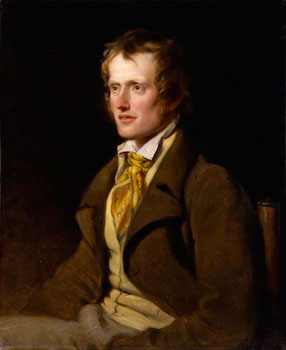
The poet John Clare
Please email me should you have a comment or query relating to this post.
← Photographing churches | Post Archive | Too many strawberries →