The creation of visual art is widely varied, not only in terms of the medium used, be in a digital sensor or oil paint, but also in the final form in which the artist presents their work. Although the single painting, photograph or composite has always been my favourite, I have also been drawn to works of art made up of different images arranged together, in particular the triptych.
The triptych (traditionally a painting made up of three sections) originated from early Christian art, and was primarily associated with altarpieces, although over time the form was used by artists in a range of contexts, including sculpture and paintings with non-religious themes, such as ‘Carnival’ by Max Beckmann.
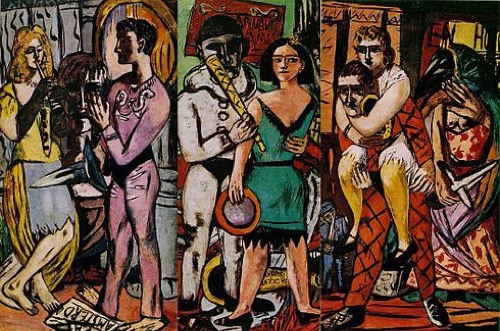
‘Carnival’ by Max Beckman, Oil On Canvas, 1943.
Hieronymus Bosch is a painter associated most strongly with the Triptych form (having apparently produced at least sixteen), his most famous being “The Garden of Earthly Delights,” an utterly astonishing (and in many ways alarming) work of art which I would suggest deserves closer scrutiny. To me the painting is reminiscent of Salvador Dali's work, and the reader may be interested in this article by Anthony Christian that suggests Bosch was in fact the first Surrealist. Apart from the incredible imagery in the painting, the biggest surprise to me is that it was completed some time between 1490 and 1510. A very detailed image of the triptych can be downloaded from Wikipedia (see link above).
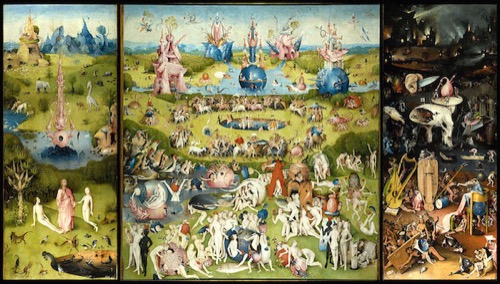
Hieronymus Bosch, The Garden Of Earthly Delights, Oil On Oak Panels, 220 X 389 Cm, Museo Del Prado, Madrid.
Works like The Garden of Earthly Delight are obviously created to tell a story, and this is a theme of many triptychs, including more modern examples like that of “The Pioneer,” a painting completed in 1904 by Frederick McCubbin, which tells the rather melancholic story of a family's life in the Australian bush.
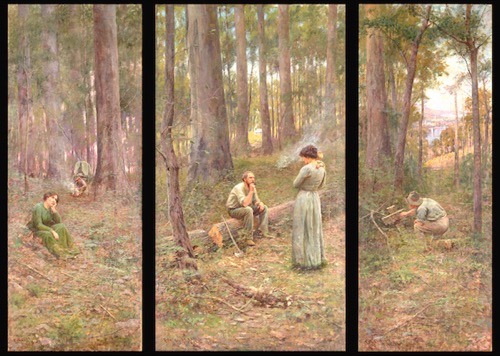
Frederick Mccubbin - The Pioneer - Google Art Project
The triptych in photography
Triptychs are used frequently in photography, and can be vertically as well as horizontally aligned, usually with plain borders. Although in my own work I tend to use separate images, photographers also divide a larger image into three.
As in paintings, photographic triptychs can be used to tell a story, even a humorous one as the image below (taken on a local walk) demonstrates.
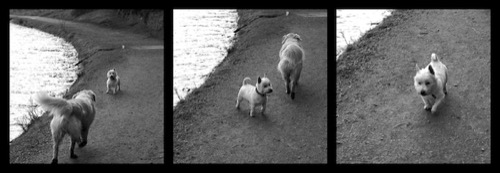
Indifference.
More often however, photographic triptychs are used to group photographs of similar types together. For the digital photographer this can be done readily, and I would recommend a tutorial by Julieanne Kost (one of Adobe's Principle Evangelists), for help on how to create such works. This is a well put together resource provided free to creative artists, and I used the techniques included in the tutorial myself when combining the images below.
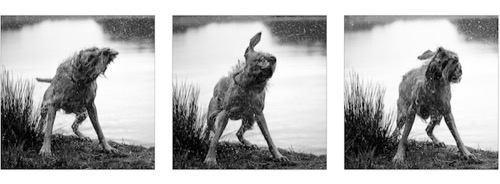
Shake.
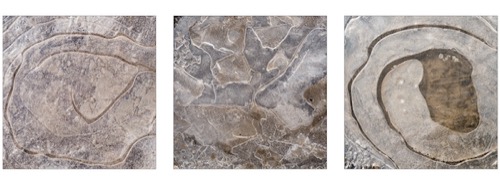
Triple Ice.
Please email me should you have a comment or query relating to this post.
← Flat, soulless and stupid | Post Archive | A walk in Suffolk →